Monday, January 29, 2007

Sonic Wash II - Editing

Having recorded the sounds to separate channels on the multi-track I can now reconstruct the mix in order to begin choosing sequences.

It's interesting to see the differences between the mic recordings. I have boosted the levels to get the maximum amplification of each part. There are 7 independent tracks in total:

Some of the tracks had significant audible noise, especially the one from the mic which was placed outside. I think I can get round this by choosing extracts carefully when it comes to building the instrument.

Sunday, January 28, 2007

Sonic Wash II - Recording

The purpose of re-visiting this experiment is to obtain a more detailed recording using additional mics including one located outside.

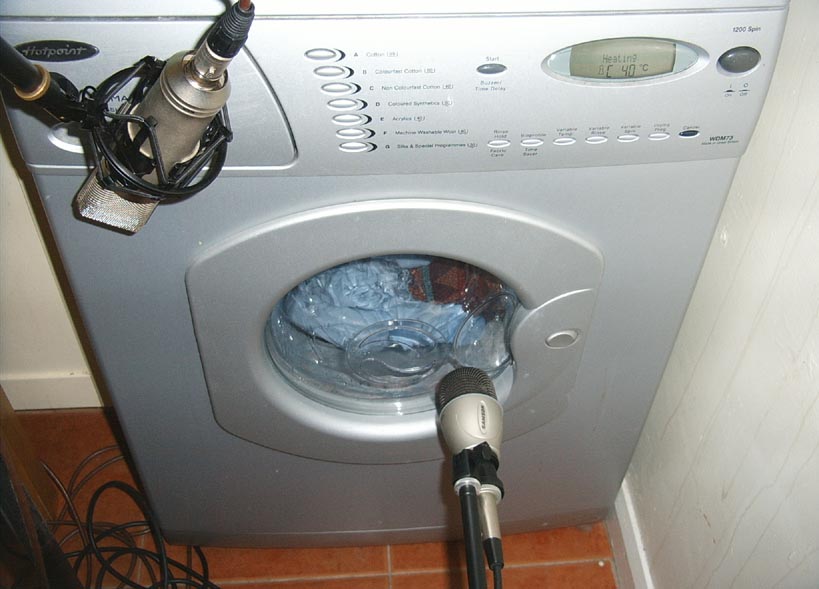
I'm using the same model and settings as in the first experiment so I may draw comparison at a later date, however unsurprisingly the contents of the drum are different:


Machine:
Model: Hotpoint WD73
Max Spin speed: 1200RPM

Wash:
Programme C: 40 degree wash
Contents of drum: 1 pair of jeans, 4 T-shirts, 11 pairs of socks, 10 pairs of shorts, 2 soap tablets, 1 tablet net.
Duration: Approx 75 mins

Mics & Locations:
1 x Rode NT4 - Channel 1 & 2 (L/R) - Room Mic
1 x Samson Q-Kick - Channel 3 - Drum Mic
1 x Stagg MC07 - Channel 4 - Dispenser Mic
1 x Plate Mic - Channel 5 - Floor Mic (Underneath)
1 x C-Ducer Contact Mic - Channel 6 - Top of machine
1 x AKG C100S - Channel 7 - Pipe Mic (Outside)

The Recording:
As before each mic is recorded to a separate track, only now I'm using more mics and an 8-track recorder. This should give me my most definitive sampled object to date.


Thursday, January 11, 2007

Alternating sound

I've found out how to change the velocities of samples and create alternations in Reason. This should make a huge difference to the instruments and give me a wider variety of sounds. I've also now got access to a multi-track recorder that can record onto 8 tracks simultaneously, so I'll have more choice of mics.

Had a play with the washing machine instrument and made some very loud noises which shook my speakers. Should proabably turn things down a bit. Need to find out how to attatch sounds to this blog.

Wednesday, December 13, 2006

Layering Sounds

Not written anything for a while but there has been progress and I've started the editing phase. I've been choosing sampled sections of the wash cycle to edit and layering them to form patches.
There's a good contrast of sound between the two mics although I still wish I'd been able to use more. I'm going to try and find a way to include sound material on this blog, or I might just switch to a myspace.com site and store sounds as tracks.

Currently making plans to record a racing car for a potential instrument. More details to follow.

Wednesday, October 11, 2006

The Sonic Washing Machine

I'm starting with the washing machine for the following reasons:

1. I have one
2. It makes a variety of sounds
3. It will look great in a photo

I wil keep a detailed account of how these samples are produced in order to make comparrisons between recordings later.

Machine:
Model: Hotpoint WD73
Max Spin speed: 1200RPM

Wash:
Programme C: 40 degree wash
Contents of drum: 4 sheets, 2 towels
Duration: Approx 75 mins

Mics & Locations:

1 x Stagg MC07 Condenser - Near water dispenser
1 x Samson Q Kick - In front of drum


The Recording:

Each mic is recorded to a separate channel so that the sounds can be adjusted independently, which falls in line with the multiple mic positions used in Propellerheads Reason Piano. The user will be able to vary the sounds heard by altering the different levels using a mixer.

I did want to use more mics, but I'm currently limited to 2-Track simultaneous recording (a limitation I will soon be resolving). I did get a good mix and it's interesting to hear the differences between the mic locations. The 'drum' mic obviously recorded more of the low rumbling sounds as the machine turned, whirred and spun, whereas the 'water dispenser' mic excellently captured the sounds of the machine filling up.


Conclusion:

This was a great first experiment and I'm looking forward to processsing the results. I think the washing machine can make a great virtual instrument. There was an excellent variety of sounds which will make for some great sampled patches. I think I should record a washing machine again and maybe include the following:


  • Sounds of the door opening & closing
  • Sounds of the selection buttons
  • Additional mic placed outside to record water drainage
  • Additional mic recording the sound of the 'space' (kitchen)
  • Additional mic placed in the drum*

* Ok so this one's risky, particularly for the mic spinning at 1200 RPM. It can only be done using a wireless model in order to prevent cable entanglement which means that it's a bit of an expensive risk. Obviously it would be shielded from the water.....hmmm I'll have a think.

Hyper-Sampling

I believe the best way to record these devices is using a technique known as 'hyper-sampling'. This is a process created by software manufacturers 'Propellerhead' in Sweden. It requires using multiple microphones, velocities and variations to record each note/sound of an instrument in order to produce a detailed virtual device known as a 'Refill', which can then be used in conjuction with their flagship software studio 'Reason 3'.

Propellerheads recently released a new refill containing a collection of highly realistic virtual pianos aptly called 'Reason Pianos'. A feature on their website explains how this refill was made, I believe I can apply the same techniques in order to develop my instruments.

Sunday, August 13, 2006

Friday, August 11, 2006

The Concept

This blog is to show the research and development of my Masters RPT in Fine Art. I have a great interest in software instruments such as synthesizers, drum machines and sampled acoustic instruments, which have all the benefits of realistic sound, without the cost, size or hassle of maintenance.

There is a huge variety of choices, but these are usually either digital versions of conventional instruments (piano, strings, guitar) or retro synthesizers (Minimoog, Korg MS20, B4). I will be examining how I can develop new virtual instruments from machines that were not designed to produced music.

Of course I'm not the first person to bang on a kitchen sink to produce a drum beat, but my intention is to extensively record physcial devices such as washing machines and car engines in order to produce digital equivalents which can be played and manipulated like a synthesizer.