Tuesday, June 05, 2007

Sonic Machines on MySpace

Setup a myspace account for hosting Sonic Machines. It's easier to add tracks and pics and is generally better for musicians. It will fill the gap till I get my website going.

http://www.myspace.com/sonicmachines

I'll still try and keep this blog up to date as it's easier to write with than the one on Myspace.

Saturday, May 19, 2007

Sonic Washing Machine live performance

Transition: Surface Gallery, Nottingham.
1st -5th May 2007


Photo by Simon Cruickshank


The Sonic Washing Machine was finally unveiled to the public with opportunities during the week for participants to try out the instrument. There was also a live performance on the opening night.

Performance Setlist:

Beep
Industrial
Programme C: 40 degrees


Sunday, April 29, 2007

SWM tracks for Transition finished!


---------- Rear View ---------- ----------- Front View -----------


------------ Snare closeup ------------

* Click on images to enlarge


Above are screenshots from the finished SWM Combinator instrument for the Transition exhibition. I've finished choosing the sounds, I've rehearsed the tracks and I'm happy with the results. The 3 patches are 'Industrial', 'Original' and 'Beep'. The Get-in starts tommorow so I'll have to de-rig this evening.

Friday, April 27, 2007

The 'Hexakick'

The 'Hexakick' is based on a Roland KD-8 electronic kick pad. This one really is to save money as it only has a single trigger. However I do really like the fact that we made it hexagon shape at it matches the Hexapad.

Seems to stand up to a good beating, it happily accomodates a double kick pedal, easy to carry. I can't fault it really, could possibly do with a coat of paint.

Sunday, April 22, 2007

The 'Hexapad'

The Hexapad will be the main percussive controller for the Sonic Washing Machine. The initial reason for constructing something 'homemade' was to reduce the risk of expensive equipment being stolen. However, the design has led to something quite revolutionary as it no longer compares to the traditional design of an electronic drumpad.

Electronic drumkits such as Roland V-Drums use a separate pad for each component (e.g. snare, toms, kick), they isolate individual sounds and try to prevent 'crosstalk'. The Heaxapad is different because it encourages blending sounds together, creating hybrids. It can even be played like a primitive mixer.


Construction process

  • 11 transducer mics are embedded into cylindrical indents in the surface of the face.
  • Holes are drilled to allow the mics to be connected to phono sockets on the rear.
  • The mics are secured with a strong glue before a sheet of adhesive foam is added for protection. Then the shotblast rubber is fused with the foam to give the required bounce.
  • Finally the sides are added, creating a shell to give it increased depth.

I'm very pleased with the result. It completely changes my way of playing and will be a huge asset to the instrument.

Saturday, April 21, 2007

Sonic Racing Car begins

I had an opportunity to visit Donington racetrack on 19th April to record some racing car sounds for the forthcoming instrument 'Sonic Racing Car'. Special thanks to Lindsay Jelly and her son Stephen who made this happen during a very busy Formula 3 test day .

There was lots of action both on the track and in the pits. Lindsay focused on capturing some video footage on a HDV camcorder whilst I did some recording using the Edirol R09. Tried a number of mics including the Beyerdynamic MCE86.2 which was incredibly sensitive.

Got some really good sounds of cars pulling into the pits and lots of whirrs and bangs and clanking. I didn't attempt a full multi-track recording as there wasn't really time and I need more preparation. Eventually I'm hoping to do a similar style recording to the washing machine using multiple mics recording specific areas.

Despite being in the middle of finishing the washing machine I felt this was an opportunity not to be missed.

Sunday, April 15, 2007

Percussive controllers

There was always the option of just having a keyboard to trigger sounds, but having discussed ideas with Andy Love we formed a team including Phil Young to help design and build a percussive controller.

We discussed numerous designs and looked at how it would be played. Some were very elaborate and may be revisited in the future.

I've discovered that there are only so many triggers that can be accessed on the TD-6 without using Roland hardware. This has had an impact on the final design which will probably be a single hexagon shaped pad with 11 embedded triggers. This allows the maximum number of different sounds available from a single surface.

Tuesday, April 10, 2007

It's all about the sound

I'm building a patch which is sounding very industrial. There's big low thumps for the kick drum and some good sharp hits for the snare. It's great that you can just keep layering sounds and adjusting levels till you get the tone you want.

The Roland TD-6 has 11 availble triggers, but I've worked out that if I can access both head and rim shots I could have up to 20 different sounds available. With a wide variation in velocity sensitivity that should add up to a good choice of audio material.

Sunday, April 08, 2007

Patch Development

I'm constructing the sonic washing machine in Reason 3 as a Combinator instrument. This is a great tool as it allows you to build complex sounds using multiple devices.

It's probably best if I layer samples using the NN-XT sampler and include a mixer to give me control over the different elements. I can also assign various effect units to give me more choices.

There are so many different controls for the sampler and I've found out how to create layer alternate sounds and use multiple velocites.

Because I want to focus on creating patches for the live set I will concentrate on sounds that will work when played as a percussive instrument. This means ensure that the 'release' values must be high in order to give the desired sound from a single hit.

Sunday, April 01, 2007

Moving forward

There's been some good progress recently. Started designing the custom controller with friends who are helping with the construction. Nothing's final yet, but it's looking percussive. Bought some shotblast rubber for the pad areas.

Sunday: Did a full technical test today by connecting up all the equipment in the chain:

Controller
(Currently drumkit)
\/
Roland TD-6
Drum module
\/
MIDISport 2x2
USB MIDI Interface
\/
PC Laptop
Running 'Reason 3'

After a rather scary half hour of not knowing why it wasn't working at all, I solved a few problems and eventually got a result (big relief). Had some great fun triggering low pitch 'drum spin' sounds using the CY12 C/R cymbal.

Now I just need to develop some really good 'combinator' patches.

Tuesday, March 27, 2007

Final Sampling

Also I finally got round to collecting the last of the samples at the weekend. This included the opening/closing sounds of the door, the dispenser, on/off switch, buttons and swirling the inside drum.

All samples were taken using an Edirol R09, simple but effective.

Exhibition 1st - 5th May

Had a busy couple of months moving jobs, but I need to finish the sonic washing machine as I shall be exhibiting at the 'Surface Gallery' in Nottingham on 1st - 5th May. This will include a live performance on the opening night for which I am exploring the best methods for controlling the instrument.

I think it will be a combination of MIDI keyboard with modified drumkit & custom built percussion. It's all very exciting!!!

Monday, January 29, 2007

Sonic Wash II - Editing

Having recorded the sounds to separate channels on the multi-track I can now reconstruct the mix in order to begin choosing sequences.

It's interesting to see the differences between the mic recordings. I have boosted the levels to get the maximum amplification of each part. There are 7 independent tracks in total:

Some of the tracks had significant audible noise, especially the one from the mic which was placed outside. I think I can get round this by choosing extracts carefully when it comes to building the instrument.

Sunday, January 28, 2007

Sonic Wash II - Recording

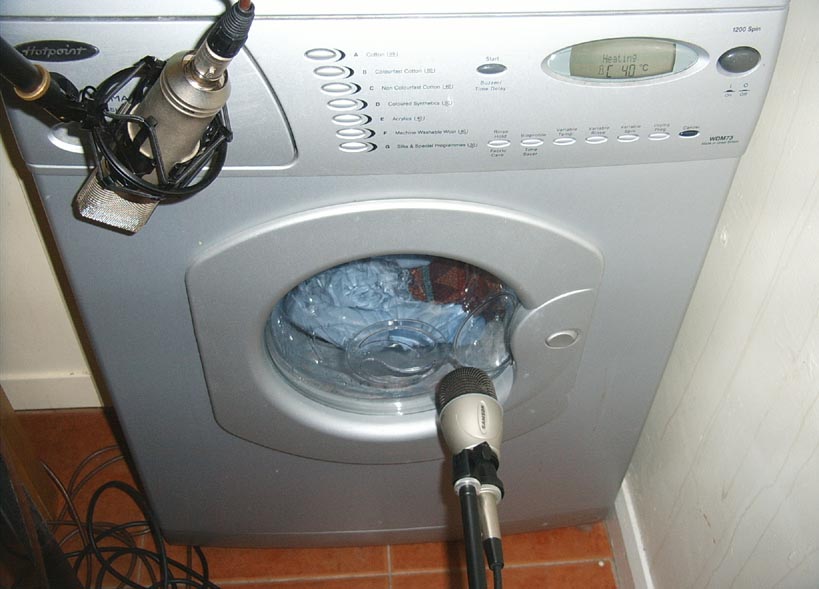
The purpose of re-visiting this experiment is to obtain a more detailed recording using additional mics including one located outside.

I'm using the same model and settings as in the first experiment so I may draw comparison at a later date, however unsurprisingly the contents of the drum are different:


Machine:
Model: Hotpoint WD73
Max Spin speed: 1200RPM

Wash:
Programme C: 40 degree wash
Contents of drum: 1 pair of jeans, 4 T-shirts, 11 pairs of socks, 10 pairs of shorts, 2 soap tablets, 1 tablet net.
Duration: Approx 75 mins

Mics & Locations:
1 x Rode NT4 - Channel 1 & 2 (L/R) - Room Mic
1 x Samson Q-Kick - Channel 3 - Drum Mic
1 x Stagg MC07 - Channel 4 - Dispenser Mic
1 x Plate Mic - Channel 5 - Floor Mic (Underneath)
1 x C-Ducer Contact Mic - Channel 6 - Top of machine
1 x AKG C100S - Channel 7 - Pipe Mic (Outside)

The Recording:
As before each mic is recorded to a separate track, only now I'm using more mics and an 8-track recorder. This should give me my most definitive sampled object to date.


Thursday, January 11, 2007

Alternating sound

I've found out how to change the velocities of samples and create alternations in Reason. This should make a huge difference to the instruments and give me a wider variety of sounds. I've also now got access to a multi-track recorder that can record onto 8 tracks simultaneously, so I'll have more choice of mics.

Had a play with the washing machine instrument and made some very loud noises which shook my speakers. Should proabably turn things down a bit. Need to find out how to attatch sounds to this blog.

Wednesday, December 13, 2006

Layering Sounds

Not written anything for a while but there has been progress and I've started the editing phase. I've been choosing sampled sections of the wash cycle to edit and layering them to form patches.
There's a good contrast of sound between the two mics although I still wish I'd been able to use more. I'm going to try and find a way to include sound material on this blog, or I might just switch to a myspace.com site and store sounds as tracks.

Currently making plans to record a racing car for a potential instrument. More details to follow.

Wednesday, October 11, 2006

The Sonic Washing Machine

I'm starting with the washing machine for the following reasons:

1. I have one
2. It makes a variety of sounds
3. It will look great in a photo

I wil keep a detailed account of how these samples are produced in order to make comparrisons between recordings later.

Machine:
Model: Hotpoint WD73
Max Spin speed: 1200RPM

Wash:
Programme C: 40 degree wash
Contents of drum: 4 sheets, 2 towels
Duration: Approx 75 mins

Mics & Locations:

1 x Stagg MC07 Condenser - Near water dispenser
1 x Samson Q Kick - In front of drum


The Recording:

Each mic is recorded to a separate channel so that the sounds can be adjusted independently, which falls in line with the multiple mic positions used in Propellerheads Reason Piano. The user will be able to vary the sounds heard by altering the different levels using a mixer.

I did want to use more mics, but I'm currently limited to 2-Track simultaneous recording (a limitation I will soon be resolving). I did get a good mix and it's interesting to hear the differences between the mic locations. The 'drum' mic obviously recorded more of the low rumbling sounds as the machine turned, whirred and spun, whereas the 'water dispenser' mic excellently captured the sounds of the machine filling up.


Conclusion:

This was a great first experiment and I'm looking forward to processsing the results. I think the washing machine can make a great virtual instrument. There was an excellent variety of sounds which will make for some great sampled patches. I think I should record a washing machine again and maybe include the following:


  • Sounds of the door opening & closing
  • Sounds of the selection buttons
  • Additional mic placed outside to record water drainage
  • Additional mic recording the sound of the 'space' (kitchen)
  • Additional mic placed in the drum*

* Ok so this one's risky, particularly for the mic spinning at 1200 RPM. It can only be done using a wireless model in order to prevent cable entanglement which means that it's a bit of an expensive risk. Obviously it would be shielded from the water.....hmmm I'll have a think.

Hyper-Sampling

I believe the best way to record these devices is using a technique known as 'hyper-sampling'. This is a process created by software manufacturers 'Propellerhead' in Sweden. It requires using multiple microphones, velocities and variations to record each note/sound of an instrument in order to produce a detailed virtual device known as a 'Refill', which can then be used in conjuction with their flagship software studio 'Reason 3'.

Propellerheads recently released a new refill containing a collection of highly realistic virtual pianos aptly called 'Reason Pianos'. A feature on their website explains how this refill was made, I believe I can apply the same techniques in order to develop my instruments.

Sunday, August 13, 2006

Friday, August 11, 2006

The Concept

This blog is to show the research and development of my Masters RPT in Fine Art. I have a great interest in software instruments such as synthesizers, drum machines and sampled acoustic instruments, which have all the benefits of realistic sound, without the cost, size or hassle of maintenance.

There is a huge variety of choices, but these are usually either digital versions of conventional instruments (piano, strings, guitar) or retro synthesizers (Minimoog, Korg MS20, B4). I will be examining how I can develop new virtual instruments from machines that were not designed to produced music.

Of course I'm not the first person to bang on a kitchen sink to produce a drum beat, but my intention is to extensively record physcial devices such as washing machines and car engines in order to produce digital equivalents which can be played and manipulated like a synthesizer.